
“But I am a worm, and no man; a reproach of men, and despised of the people.”
— Psalm 22:6
These words are part of Psalm 22, written centuries before the birth of Christ. It is the same psalm Jesus quoted while He was on the cross when He said, “My God, my God, why hast thou forsaken me?” (Psalm 22:1; Matthew 27:46). After the words Jesus quoted, a rather particular expression appears in the same psalm: “But I am a worm, and no man.”
In the Hebrew text, the word translated as “worm” is tola’at. The term is also associated with the color scarlet, since this type of insect was used to produce the crimson-red dye used in ancient times.
The life cycle of this insect has recently drawn the attention of many Christians because of its particular characteristics. One of them is found precisely in the way the female protects her eggs. She remains fixed to the branches of the tree and lays her eggs beneath her body. At the end of the process, she dies there, and her hardened body continues to protect them. A crimson pigment can also be obtained from this insect and used to produce red dyes. In addition, it produces whitish wax secretions during its life cycle.
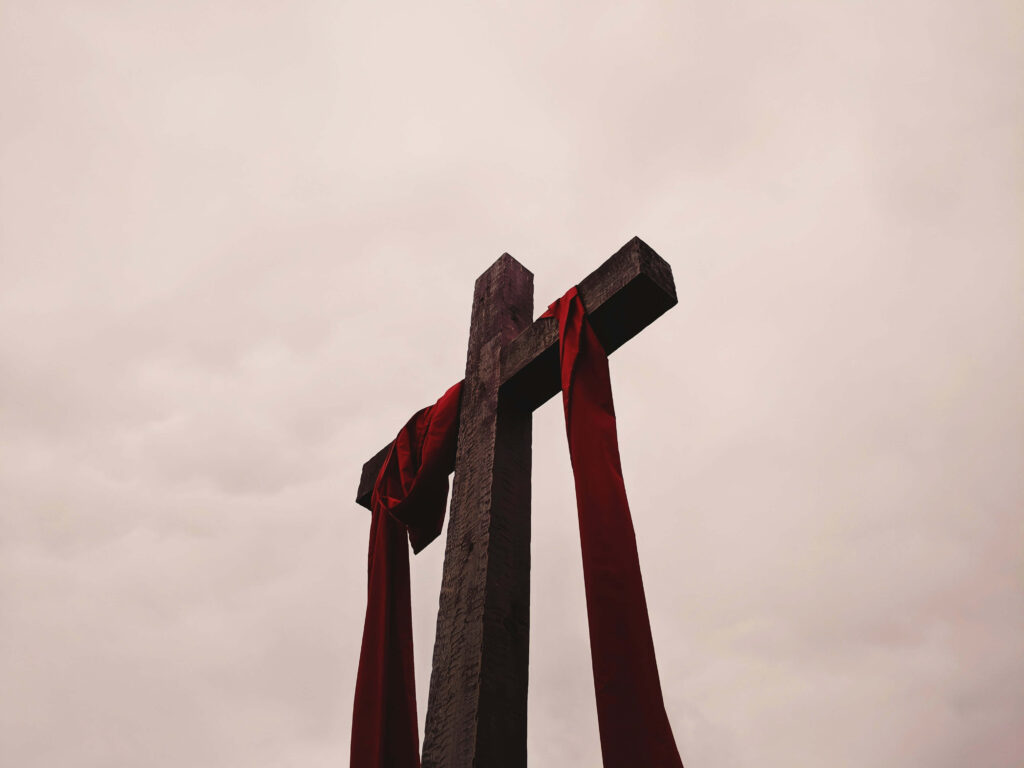
When you read these details alongside Psalm 22, it is easy to understand why many believers have seen a resemblance to the crucifixion: Christ upon the wood, His blood shed, and His life given for us.
Although the Bible does not say that the life cycle of the scarlet worm was a prophecy of the crucifixion, it is an extremely interesting comparison and an image that reminds us of Christ.
As for what we can affirm from the Bible, Psalm 22 is closely connected to what happened at the cross. Jesus spoke the words with which the psalm begins while He was being crucified. Later, the same psalm speaks of someone despised by the people: “But I am a worm, and no man; a reproach of men, and despised of the people.” Isaiah also described the Messiah as “despised and rejected of men” (Isaiah 53:3).
Christ’s humiliation went as far as death. Philippians 2:8 says that He “humbled himself, and became obedient unto death, even the death of the cross.” God Himself had come and allowed Himself to be rejected, betrayed, mocked, and ultimately crucified out of love for us.
His blood also holds a central place in our redemption. Ephesians 1:7 says, “In whom we have redemption through his blood, the forgiveness of sins.” Hebrews 9:12 adds that Christ entered “once into the holy place, having obtained eternal redemption for us.” When we think about the scarlet color associated with tola’at, it is understandable that our thoughts turn to the blood Jesus shed for us.
Perhaps we may never know whether there was any additional intention behind the use of that word in Psalm 22. After all, God Himself was the One who designed the scarlet worm. Nor do we need to claim that there was in order to appreciate the comparison.
He knew what awaited Him and was willing to go through it. Jesus Himself said about His life, “No man taketh it from me, but I lay it down of myself” (John 10:18). He was despised and humiliated, and even so, He willingly offered Himself for us.
A small scarlet worm can remind us of that story. However, what makes the story important is not the worm. It is Christ, who was willing to give His life so that you and I could be redeemed.
Photo by Alicia Quan on Unsplash
© 2025 Perennial Word. All rights reserved.


Very shortly this web site will be famous amid all blog visitors,
due to it’s nice posts
Wow, marvelous blog layout! Ηow ⅼong have you been blogging for?
you made blogging look easy. The overall
ⅼook of your website is great, ⅼet al᧐ne the content!
Here is my web blog: fintechbase
Incredible! i’ve been searching for something similar.
i appreciate the info
Hi there! I know this is kinda off topic however , I’d
figured I’d ask. Would you be interested in trading links or maybe guest writing a blog post
or vice-versa? My site goes over a lot of the same topics as yours and I believe
we could greatly benefit from each other. If you might be interested feel free to send me an email.
I look forward to hearing from you! Terrific blog by
the way!
Link exchange is nothing else except it is simply placing the
other person’s webpage link on your page at appropriate
place and other person will also do similar in favor of you.
Woah! I’m really loving the template/theme of this site.
It’s simple, yet effective. A lot of times it’s tough to
get that “perfect balance” between superb usability and appearance.
I must say you have done a very good job with this.
In addition, the blog loads extremely quick for me on Internet explorer.
Excellent Blog!
each time i used to read smaller articles that also clear their motive,
and that is also happening with this paragraph which I am
reading at this place.
I felt like your post is relevant and timely, either) and living life with appreciation for Nature, keeps people feeling grounded.
Philosophizing about important topics is likewise an experience that can help us
know ourselves.