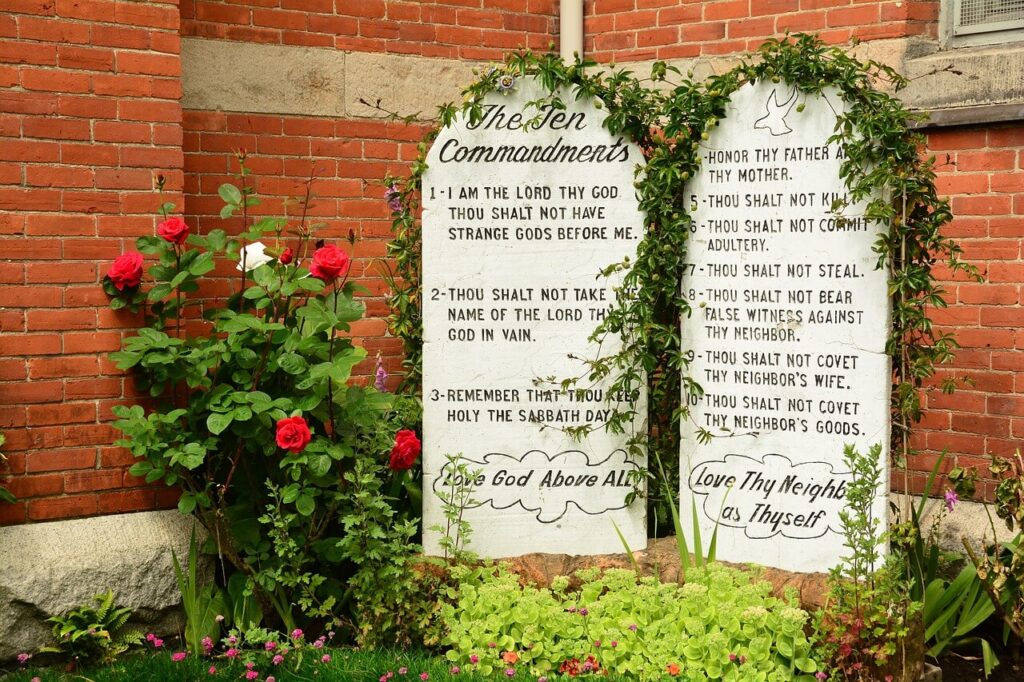
Throughout Scripture, God reveals His will to us through commandments. In the Bible, this word is closely related to terms such as law, word, instruction, and decree. Although some passages do not literally use the word “commandment,” the entire Word of God should be received as divine authority. 2 Timothy 3:16 says: “All scripture is given by inspiration of God, and is profitable for doctrine, for reproof, for correction, for instruction in righteousness.”
I Am the LORD Thy God
In Exodus 20:1–17, we find one of the most important revelations of the Old Testament: the Ten Commandments, given directly by God to the people of Israel. They were not invented by men, nor were they mere suggestions. They were sacred words spoken by God Himself, who descended upon Mount Sinai and gave them to His people as part of His covenant and as moral guidance for their lives.
Exodus 20:1–17 (KJV)
1 And God spake all these words, saying,
2 I am the LORD thy God, which have brought thee out of the land of Egypt, out of the house of bondage.
3 Thou shalt have no other gods before me.
4 Thou shalt not make unto thee any graven image, or any likeness of any thing that is in heaven above, or that is in the earth beneath, or that is in the water under the earth:
5 Thou shalt not bow down thyself to them, nor serve them: for I the LORD thy God am a jealous God, visiting the iniquity of the fathers upon the children unto the third and fourth generation of them that hate me;
6 And shewing mercy unto thousands of them that love me, and keep my commandments.
7 Thou shalt not take the name of the LORD thy God in vain; for the LORD will not hold him guiltless that taketh his name in vain.
8 Remember the sabbath day, to keep it holy.
9 Six days shalt thou labour, and do all thy work:
10 But the seventh day is the sabbath of the LORD thy God: in it thou shalt not do any work, thou, nor thy son, nor thy daughter, thy manservant, nor thy maidservant, nor thy cattle, nor thy stranger that is within thy gates:
11 For in six days the LORD made heaven and earth, the sea, and all that in them is, and rested the seventh day: wherefore the LORD blessed the sabbath day, and hallowed it.
12 Honour thy father and thy mother: that thy days may be long upon the land which the LORD thy God giveth thee.
13 Thou shalt not kill.
14 Thou shalt not commit adultery.
15 Thou shalt not steal.
16 Thou shalt not bear false witness against thy neighbour.
17 Thou shalt not covet thy neighbour’s house, thou shalt not covet thy neighbour’s wife, nor his manservant, nor his maidservant, nor his ox, nor his ass, nor any thing that is thy neighbour’s.
Each commandment reflects an aspect of God’s character: His holiness, His justice, His love, and His desire for us to live in harmony with Him and with one another.
Why Should We Obey the Commandments?
The simple fact that they come from God should be reason enough for us to obey them. He is sovereign, holy, and just. He does not need to justify Himself to us. Yet, out of love, He has given us His Word so that we may know His will and walk in His ways. Psalm 19:8 says: “The statutes of the LORD are right, rejoicing the heart: the commandment of the LORD is pure, enlightening the eyes.”
Notice how it says they rejoice the heart. Of course they do! Imagine living in a world where you could trust what people tell you without worrying about being deceived, where you could go wherever you wanted without having to worry about anything. The commandments are not a burden, but a blessing. They are a manifestation of God’s love for His children, and when we obey them, our lives align with His purpose.
Restriction or Freedom?
“For this is the love of God, that we keep his commandments: and his commandments are not grievous” (1 John 5:3).
Many people see the commandments as a list of prohibitions. They become afraid and reject the idea of “restrictive” rules. Others prefer to modify the commandments to suit themselves so they can feel justified. Some even hide behind a commandment to justify what they are doing. The truth is that God did not give us His commandments to limit us, but to set us free. He gave them to preserve life, not to ruin it. What many people fail to realize is that the commandments are God’s divine laws and a reflection of His love for us. God gave us His law as a gift so that we could live life to the fullest, not feel restricted. Every word that comes from His mouth is meant to guide us, correct us, and draw us closer to Him.
Can you imagine a society without laws? It would be chaos! God’s laws teach us essential principles for living in society. Many of those principles are also reflected in our values and laws today, since many of the values we know today have their roots in God’s commandments and His Word. How important God’s laws are! Without His law, we would not know how to distinguish between good and evil. Every day, we would live in fear of being deceived, robbed, or murdered. Thank God we can live safer and more peaceful lives.
I think we can visualize this better in the following way: when we look at the commandments as a whole, we can see how powerful they are and how much they protect our well-being. Take the commandment not to kill: what would happen if everyone killed? Take the commandment not to steal: what would happen if everyone stole? We could go through them one by one, and you might say, “But you’re exaggerating.” Well, that’s how important they are! Now let’s go to the other extreme: what would happen if nobody killed or stole? See where I’m going with this? The commandments are a little piece of heaven. In heaven, nobody steals, nobody kills… So, if you don’t like the commandments, I have some news for you: that’s how people live in heaven.
God does not want us to live in disorder, pain, or destruction. The commandments teach us to live in a way that does not cause suffering to others through our selfishness, violence, lies, greed, or pride. Each commandment protects a vital part of our lives: our worship, our rest, our family, our relationships, our truth, and our inner peace.
Jesus and God’s Commandments
Jesus Himself gave us an example of obedience to the Father’s will. During His life on earth, He lived without sin and remained faithful to God. In John 15:10, He Himself said: “If ye keep my commandments, ye shall abide in my love; even as I have kept my Father’s commandments, and abide in his love.” If Jesus, being the Son of God, obeyed His Father’s commandments, how much more should we strive to obey them!
Furthermore, Jesus made it clear that He had not come to destroy God’s law. In Matthew 5:17–18, He said: “Think not that I am come to destroy the law, or the prophets: I am not come to destroy, but to fulfil. For verily I say unto you, Till heaven and earth pass, one jot or one tittle shall in no wise pass from the law, till all be fulfilled.”
Jesus did not come to teach us something contrary to God’s law, as some people think. He fulfilled the law and showed us how to live according to God’s will, teaching us to understand His commandments beyond their literal meaning. For example, in Matthew 5:27–28, Jesus said: “Ye have heard that it was said by them of old time, Thou shalt not commit adultery: But I say unto you, That whosoever looketh on a woman to lust after her hath committed adultery with her already in his heart.” Jesus took this commandment even further! He taught us that it is not enough to avoid physically committing adultery, because we must also guard our thoughts and desires.
Sometimes we think that God was stricter in the Old Testament and that Jesus came to soften His commandments, but I believe Jesus was even more demanding. He taught us that obeying God involves much more than following rules literally. We must understand them and apply them in their fullest sense, even in the things that others cannot see, but God can.
Furthermore, this prevents people from hiding behind a commandment to justify their actions, as some of the Pharisees did. Jesus often confronted this way of practicing religion, where so much attention was given to outwardly following the rules that matters such as justice, mercy, and faith were neglected (Matthew 23:23). No wonder some of them were so upset with Him! Jesus was teaching them that they could not justify themselves simply because they followed certain rules while their hearts were far from God. This should also make us reflect on ourselves, because it is very easy to point out what others are doing wrong while justifying our own attitudes.
Only Two Commandments
On one occasion, when a lawyer asked Jesus which was the greatest commandment, Jesus answered: “Thou shalt love the Lord thy God with all thy heart, and with all thy soul, and with all thy mind. This is the first and great commandment. And the second is like unto it, Thou shalt love thy neighbour as thyself. On these two commandments hang all the law and the prophets” (Matthew 22:37–40).
Jesus summarized the law in loving God and loving our neighbor. Only two commandments, but these two commandments are the foundation of all the others. If we look at the Ten Commandments, we can see how the first four relate to our duty toward God, while the last six teach us how we should treat others.
These two commandments are enormous, and they help me understand why Jesus summarized the entire law in them. I believe one of the reasons God descended upon Mount Sinai and gave such specific commandments was that the idea of loving God and our neighbor, by itself, might have been too vague for the people of Israel at that time. Although these principles were already present in the law, they needed specific instructions to understand how to apply them in their lives.
Now, with the teachings of Jesus, we can think beyond that. He opened our minds to other ways in which we can sin, even when we believe we are literally keeping the commandments. He opened our minds to heaven, helping us better understand how God wants us to live.
That is why I consider these two commandments to be so great. When we truly love God, we desire to obey Him, and when we love our neighbor, we try not to cause them harm. Love and obedience go hand in hand.
Obedience and Salvation
Some Christians believe that keeping the Ten Commandments will grant them salvation, but we must remember that we are saved by God’s grace through faith in Jesus Christ (Ephesians 2:8–9). We keep His commandments because we love Him and desire to obey Him. Others think that because they are Christians, they are exempt from following God’s law, but faith does not make the law void; rather, it establishes it (Romans 3:31). We also know that genuine faith expresses itself through obedience.
Obedience That Transforms the Heart
Obeying the commandments is not an act of empty religiosity, but an act of love and reverence toward God. When we sincerely live by them, they become tools that shape our character. They help us identify bad habits, correct our attitudes, and grow in integrity. They are a mirror that shows us where we are and where we need to go.
“Blessed are the undefiled in the way, who walk in the law of the LORD” (Psalm 119:1).
A Call to Live by the Word
The commandments are not just meant to be read. God wants us to meditate on them, teach them, and engrave them upon our hearts. They should not be forgotten words, but living principles that guide our steps every day. I really like what Psalm 119:11 says: “Thy word have I hid in mine heart, that I might not sin against thee.” Sometimes we can get lost in the poetry and beautiful words of the Bible, but we must always remember that these are truths we actually need to apply every single day. All of us. Just because you’re the most Christian person or the prettiest one doesn’t mean you’re exempt. No, everyone.
“And these words, which I command thee this day, shall be in thine heart: And thou shalt teach them diligently unto thy children…” (Deuteronomy 6:6–7).
Our Goal: To Please God
Living according to the commandments means living in communion with the Father. Obeying God helps us have a better relationship with Him, and who wouldn’t want that? So we obey out of love, not fear. It means making obedience an expression of faith and gratitude for the salvation we have received in Christ.
“But be ye doers of the word, and not hearers only…” (James 1:22).
“Let us hear the conclusion of the whole matter: Fear God, and keep his commandments: for this is the whole duty of man” (Ecclesiastes 12:13).
The commandments are the language of God’s love expressed through instruction. His entire Word is our compass for living according to His will. Through them, God tells us, “This is My way: walk in it.” And when we do, we find peace, justice, hope… and a life where every step brings us closer to His purpose.
Image credit: Photo courtesy of Unsplash
Originally published on my former blog, Perennidad (November 15, 2020). Revised and adapted for publication on Perennial Word.
© 2025 Perennial Word. All rights reserved.